Why the filter matters
The filter sits at the bottom of your dishwasher's tub and acts as the last line of defence before water is recirculated over your dishes. Its job is to catch food particles, grease, and debris so they don't get sprayed back onto your plates. Over time, this debris builds up and restricts water flow. When that happens, you'll notice dishes coming out with a gritty residue, a bad smell inside the machine, or water pooling at the bottom after a cycle. None of this means your dishwasher is broken — in most cases, a simple filter clean is all it takes to restore full performance.
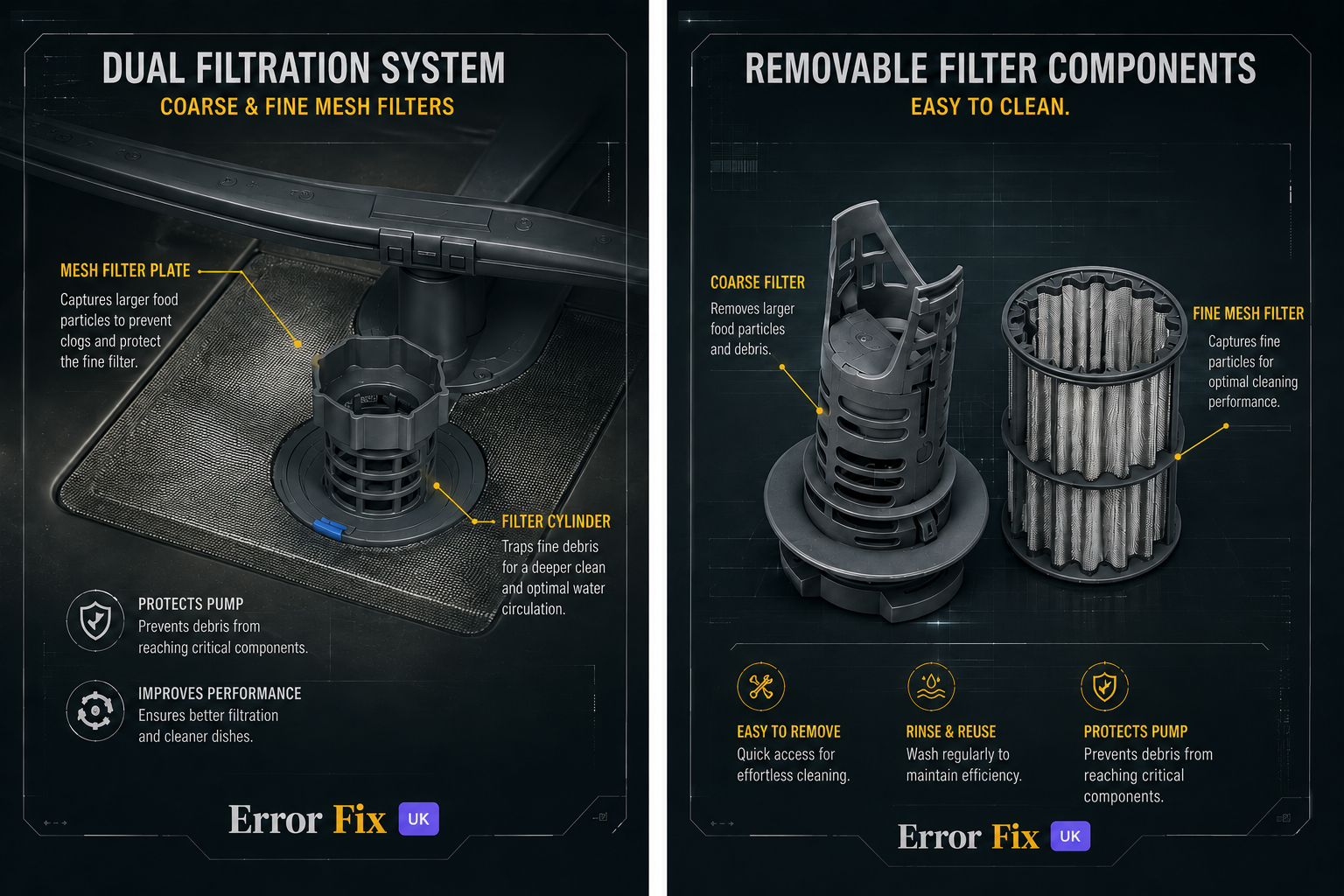
What the filter looks like
Neff dishwashers (like many Bosch Group machines) use a two-part filter system located in the centre of the dishwasher floor, just beneath the lower spray arm. The system consists of two components that work together. The first is the coarse mesh filter — a flat, circular plate made of fine mesh that lies flat on the floor of the tub. This catches larger pieces of food and debris. The second is the cylindrical micro-filter — a tall, round tube that screws into the centre of the flat filter. This finer component filters out smaller particles that the flat mesh misses. Both parts need to be removed and cleaned together.
Always switch your dishwasher off at the mains (or press the power button until it is fully off) before reaching inside. Never attempt to remove the filter while the machine is mid-cycle or still powered on.
How to remove the filter
Step 1: Open the dishwasher door fully and pull out the lower basket. Set it aside so you have clear access to the floor of the tub. Step 2: Look at the centre of the tub floor. You will see the cylindrical filter tube sticking up slightly, surrounded by the flat mesh plate. Step 3: Grip the cylindrical filter by its top (it usually has a small handle or ribbed grip). Rotate it anti-clockwise — most models require about a quarter turn. You will feel it unlock. Step 4: Lift the cylinder straight up and out of the tub. Step 5: With the cylinder removed, the flat mesh filter should now lift freely. Slide your fingers underneath its edge and lift it out. Step 6: You may also notice a small guard or coarse screen beneath the flat filter in some models — this can usually be lifted out too. Set all parts aside on a clean surface.
How to clean the filter
Step 1: Take both filter parts to your kitchen sink. Hold them under warm running water to rinse away loose food particles and grease. Step 2: Fill your sink with warm water and add a small squirt of washing-up liquid. Submerge both filter parts and leave them to soak for two to three minutes — this loosens stubborn grease. Step 3: Use a soft-bristled brush (an old toothbrush works perfectly) to scrub all surfaces of both filters. Pay particular attention to the mesh on the flat filter and the fine perforations on the cylinder — these are where debris gets trapped. Step 4: Hold the filters up to the light. If you can see through the mesh clearly, they are clean. If you spot blockages, continue scrubbing with the brush. Step 5: Rinse both parts thoroughly under running water until all soap and debris is gone. Step 6: While the filters are out, use a damp cloth to wipe around the filter housing in the base of the tub. Remove any debris that has collected in the sump area.
Do not use abrasive scourers, wire brushes, or harsh chemicals on the filter. These can damage the fine mesh and reduce its effectiveness. Stick to warm water, washing-up liquid, and a soft brush.
How to reinstall the filter
Step 1: Make sure both filter parts are fully rinsed and free of soap. Step 2: Lower the flat mesh filter back into its position on the tub floor. Line up any locating tabs or notches with the slots in the sump housing — the filter should sit completely flat and flush with the floor. Step 3: Insert the cylindrical filter back into the centre hole of the flat filter, pressing it gently downward. Step 4: Rotate the cylinder clockwise until it locks into place — you should feel or hear a click. Give it a gentle tug upward to confirm it is secure. If it comes out easily, rotate it a little further until it locks properly. Step 5: Slide the lower basket back into the dishwasher. Step 6: You are done. You can now run a normal cycle.
A correctly fitted filter sits completely flat on the tub floor with no rocking or raised edges. If the filter feels loose or uneven, remove it and try again — an unsecured filter can rattle during cycles and reduce cleaning performance.
How often should you clean it
For most households, cleaning the filter once a month is enough to keep the dishwasher running well. However, if you regularly wash heavily soiled pots and pans, cook with a lot of oil or grease, or run the dishwasher every day, you may need to clean it every two weeks. A good habit is to do a quick visual check each time you load the machine — if you can see debris building up on the mesh, it is time for a clean.
Affiliate link — we may earn a small commission at no extra cost to you. Disclosure
Signs the filter needs attention
There are several tell-tale signs that your filter is overdue a clean. Dishes and glasses coming out cloudy, greasy, or with food residue on them is the most common sign. A bad smell from inside the dishwasher — often described as musty or like stale food — is another indicator, as trapped debris begins to decompose inside the filter. Water sitting at the bottom of the tub after a cycle has finished can also point to a partially blocked filter restricting drainage. In some cases, a dirty filter may trigger a fault code — Neff dishwashers commonly display E22, E24, or E25 codes when a filter or drainage issue is detected.
Troubleshooting after cleaning
If your dishwasher is still not performing well after cleaning the filter, there are a few other things to check. Inspect the spray arms — hold each one up and look through the small holes. If any are blocked with limescale or debris, soak them in warm water and use a cocktail stick to clear each hole. Check that the filter is correctly seated and locked — a loose filter can allow debris to bypass it entirely. Run a hot maintenance wash using a dishwasher cleaner tablet to remove grease and limescale from the inside of the machine. If the problem persists or you are seeing a fault code, use the links below to find the relevant error code guide for further diagnosis.
Adding a small amount of dishwasher salt (if your model has a salt compartment) and keeping the rinse aid topped up will help prevent limescale build up on the filter and spray arms, reducing how often you need to clean them.